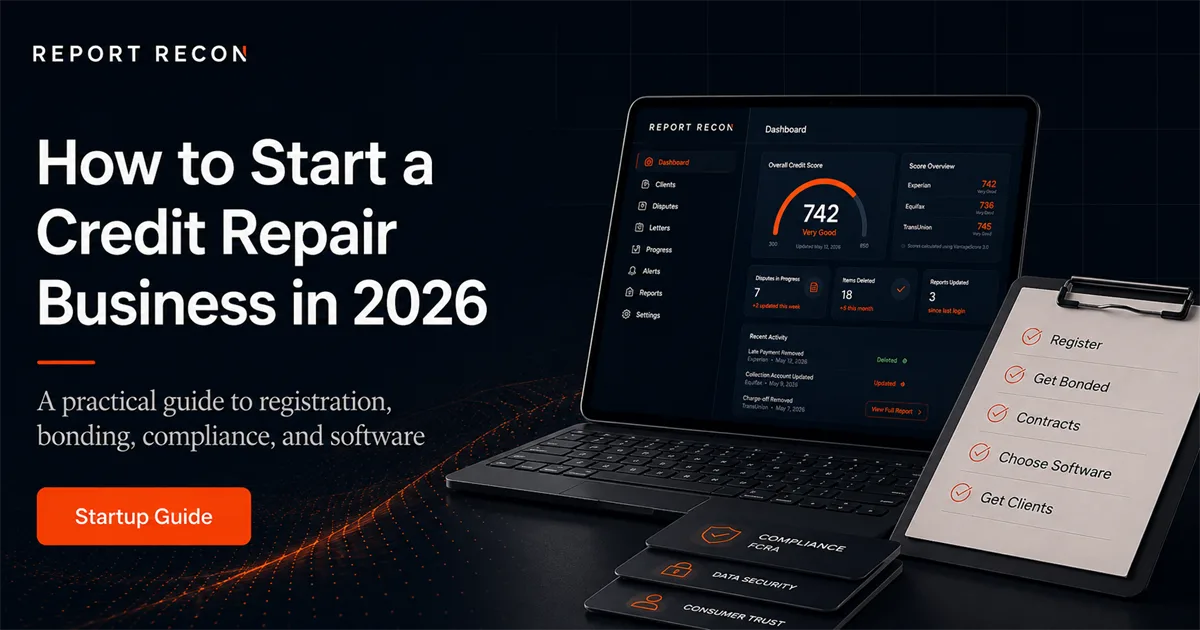
Starting a credit repair business requires registration in the right places, a bond in most states, and contracts that follow the same federal law that just cost Lexington Law's parent company $2.7 billion. A law degree is optional.
Follow this sequence.
1. Know the laws that apply to you
CROA (the Credit Repair Organizations Act) is federal and applies no matter where you operate. Two provisions matter most when you're setting up: you can't collect payment until the service is fully performed, and every client gets a 3-business-day right to cancel after signing. Build both into your contracts from day one. Retrofitting a compliant contract after you already have clients is a worse position to be in.
State law is where it gets specific, and it varies a lot. Most states regulate credit repair under a "Credit Services Organization" (CSO) statute, and many require registration plus a surety bond before you can legally charge anyone.
One more if you sell by phone: the FTC's Telemarketing Sales Rule (16 CFR 310.4(a)(2)) bars charging for credit repair sold through telemarketing until the timeframe you promised has passed and a consumer report, issued more than six months after the promised results, proves them. If your sales calls are outbound, plan your fee timing around it.
2. Register and get bonded
Bond amounts range from $5,000 to $100,000 in most states, and a few regulators can require more (Kansas starts at $25,000 and its commissioner can raise it to $1,000,000). A few examples:
- Texas. $10,000 bond or surety account, filed with the Secretary of State under Finance Code Chapter 393, and only required if you charge before completing the work. The Secretary of State is a filing office, not a regulator; enforcement runs through the Attorney General and local prosecutors. Our guide to starting a credit repair business in Texas covers the full registration and disclosure checklist.
- California. $100,000 bond under the CSO Act (Cal. Civ. Code §§ 1789.10–1789.26), plus mandatory state registration.
- Illinois. $100,000 bond under the Credit Services Organizations Act (815 ILCS 605) if you charge or receive any money before fully completing the services. Registration is required either way.
- Georgia. No bond path at all. Operating a for-profit credit repair services organization is a misdemeanor under O.C.G.A. § 16-9-59, with exemptions limited to attorneys, licensed lenders, banks, real estate brokers, and 501(c)(3) nonprofits. Don't plan a Georgia launch without one of those exemptions.
- Delaware. $15,000 bond or surety account under 6 Del. C. ch. 24, only required if you charge before completing the work. Registration with the Secretary of State is required either way, before you do any business in the state.
Check your specific state before you do anything else. Some states require a bond, some just require registration, and a handful require neither. The bond protects your clients, not you. It's a financial guarantee the state can pay out from if you don't deliver what you promised.
3. Decide your pricing model before you touch software
There are four common models in this industry: monthly subscription, flat one-time fee, pay-per-delete, and credit-based DIY tools if you're building a smaller operation. Each has real tradeoffs on cash flow and how clients perceive you. Our consumer credit repair pricing breakdown covers what each model actually costs a client and where the money goes, worth reading before you set your own rates.
4. Build compliant contracts and disclosures
At minimum, every client agreement needs: the CROA-required disclosures, the 3-business-day cancellation notice, a clear description of services, and your fee structure spelled out (not collected in advance, per CROA). If your state requires additional disclosures on top of CROA, your registration paperwork will typically spell those out. Get a lawyer to review your contract template once before you use it on a real client. That's a few hundred dollars now against a much bigger problem later.
5. Choose your software
Don't buy a $700-a-month platform before you have five clients to justify it. Start with whatever gets you dispute letters and basic case tracking without locking you into a long-term commitment. Our best credit repair and dispute software for businesses comparison covers five real platforms, ranging from pay-as-you-go entry points to full CRM suites, so you can match the tool to your actual client count instead of overbuying on day one.
6. Get your first clients
Referral relationships with real estate agents, auto dealers, and mortgage brokers tend to outperform cold marketing in this industry, since those professionals already have clients who need a credit fix to qualify for what they're buying. Your first handful of clients are also your case studies. Deliver for them before you scale spend on acquisition.
Starting from home
Most of the steps above don't require a physical office. Registration, bonding, contracts, and software all work the same whether you're running this from a spare bedroom or a storefront. What changes is how you present yourself to clients (a scheduled video or phone consultation instead of a walk-in office) and how you handle document security, since you're still collecting SSNs and ID copies and need a real system for storing them, not a folder on a personal laptop.
What this actually costs to start
Rough floor: state registration fees (varies, often $50 to a few hundred), a bond premium (typically 1% to 15% of the bond amount annually, so a $10,000 Texas bond might run $100 to $150 a year, a $100,000 California bond considerably more), software (from free/pay-per-use up to hundreds a month), and whatever you spend on a compliant contract template or legal review. You can realistically get running for a few hundred to low thousands of dollars, not the tens of thousands some "start a credit repair business" courses imply. Watch out for programs charging $2,000+ to teach you what's outlined above. Most of it is public information tied to your specific state's statute.
