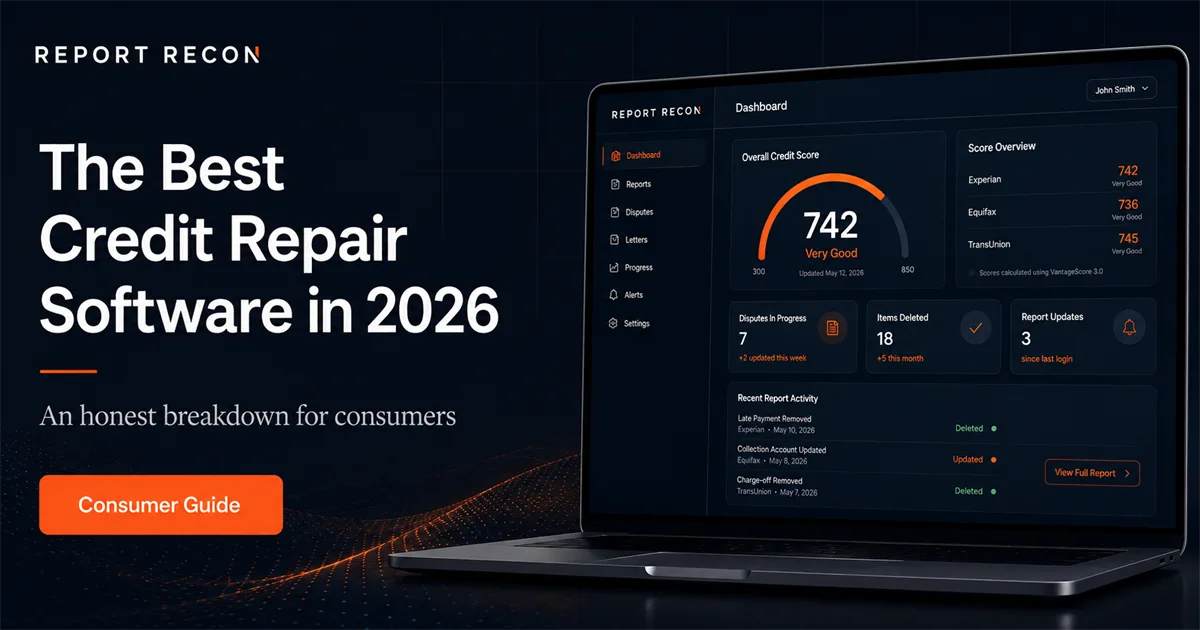
You have three ways to fix a bad credit report. Pay a company $69 to $150 a month to dispute it for you. Use DIY software built for one person's report. Or, if you run a credit repair business, use software built to manage many clients at once.
This article covers the first two, done-for-you companies and consumer DIY software. Running a credit repair business instead? See our best credit repair and dispute software for businesses comparison, which covers the client-management platforms this article doesn't.
Compare the leading options
Start here, then use the detailed sections below to verify the tradeoffs that matter for your report. Prices reflect the public offers reviewed for this article and can change.
Six representative DIY and full-service choices compared by entry price, monitoring requirements, fit, and primary tradeoff.
| Provider | Model | Starting price | Monitoring required | Best for | Primary tradeoff |
|---|---|---|---|---|---|
| Report Recon | DIY software | Free analysis; paid plans from $69/month | No | Detailed FCRA review with direct control | You review and send every dispute |
| DisputeAI | DIY software | Free software | Yes, listed at $39.99/month | Low software cost | Monitoring creates the real monthly cost |
| Dovly AI | DIY software | Free; Premium from $39.99/month | Included in service | Automated TransUnion disputes | Free and Premium disputes are TransUnion-only |
| Credit Saint | Full-service | $79.99/month plus first-work fee | Varies by plan | Established full-service support | Monthly and initial fees |
| Sky Blue Credit | Full-service | $79/month | Included | Straightforward full-service value | Ongoing monthly cost |
| JMS Consulting Firm | Full-service, pay per deletion | $297.99 processing fee plus item fees | Yes, listed at $32.99/month | Paying primarily for documented deletions | Total cost depends on items and bureaus |
Two products, two very different deals
Credit repair companies are done-for-you services. You pay a retainer. They pull your report, draft the disputes, mail them, and manage the back-and-forth with the bureaus. Lexington Law and CreditRepair.com are the biggest names here.
Consumer DIY software scans your own report, flags likely errors, and generates the dispute letters. You review them and send them yourself. Cheaper. Faster. You stay in control of what gets disputed and why.
They solve the same problem in opposite ways. Confusing them is how people overpay.
Are credit repair companies legit?
That's the single most common question people ask before spending money on this. More than which one is "best." Fair question, and the honest answer is: some are, and the industry's biggest names just lost a $2.7 billion court case over it.
In 2023 the CFPB won a $2.7 billion judgment against Lexington Law and CreditRepair.com's parent company, PGX Holdings. The court found they violated the Telemarketing Sales Rule and banned them from telemarketing credit repair for ten years.
PGX filed for bankruptcy. It shut down 80% of its operations and laid off about 900 people. The CFPB later returned $1.8 billion to 4.3 million affected consumers.
Compare each company's services and fees with the work you can do yourself.
There's also this: Consumer Reports and WorkMoney had more than 4,000 people check their own credit reports in 2024. 44% found at least one mistake. 27% found account errors serious enough to hurt their score.
Errors are common. Catching them doesn't require a law firm. And FCRA violations aren't just a dispute-letter talking point. They carry real financial consequences for whoever commits them. The law sets statutory damages of $100 to $1,000 for willful noncompliance, without the consumer having to prove a dollar loss, and courts have gone well beyond that in punitive damages when the conduct was bad enough. In Saunders v. Branch Banking & Trust Co., 526 F.3d 142 (4th Cir. 2008), a jury awarded a consumer $1,000 in statutory damages and $80,000 in punitive damages over a single FCRA violation by a bank that furnished bad information to a credit bureau, and the appeals court upheld it. FCRA also has a fee-shifting provision: if a consumer wins, the credit bureau or furnisher pays the legal fees. That's part of why accurately identifying a real violation, not just disputing an account because it's negative, is worth doing carefully.
Why identical letters are starting to fail
Here's what most "how to dispute your credit" advice from 2015 gets wrong in 2026: Experian, Equifax, and TransUnion now run automated systems that flag disputes as templated. When thousands of consumers copy the same free letter off a website and mail it in, the bureaus' systems recognize the pattern, classify it as low-priority or frivolous, and process it accordingly. Sometimes before a human reads it.
This is why several tools on this list lead with "unique letters" as a feature, not a nice-to-have. Credit Repair Cloud built an entire feature around it. Mass-produced disputes trained the bureaus to filter for sameness. The software that survives now has to write something different every time.
Report Recon's letters are generated per account, per bureau, from your specific report data. Not pulled from a shared template library. Worth checking for any tool on this list: ask whether the letters are unique to your file or a fill-in-the-blank form with your name swapped in.
Credit repair pricing isn't one model
Before you compare prices across this list, know that "credit repair pricing" means at least four different things depending on who you're talking to:
Monthly subscription. The model most companies on this list use. Pay every month the work continues, whether or not anything gets deleted that month.
Flat one-time fee. Pay once, typically $799 to $1,099, for a defined program length or unlimited disputes over some fixed window. Common enough to be its own category; search any credit repair pricing page and you'll see this range repeated.
Pay-per-delete. You only pay for items actually removed. JMS Consulting Firm runs this model: $20 per late payment, $75 per item per bureau for collections, charge-offs, and repossessions, up to $300 per bureau for public records. Nothing removed, nothing owed on that item. Two costs sit on top of the per-item fees: a $297.99 document-processing fee up front and credit monitoring at $32.99/month. Deletion billing is capped at $75/month until your balance clears, so by JMS's own math the most you'd pay in a month after the one-time setup fee is $107.99.
Credit-based DIY. What Report Recon and most of the software below use. Buy credits, spend them on analysis and letters, no ongoing commitment either way.
None of these is universally "the best" deal. Pay-per-delete sounds the safest on paper, but you're often paying more per successful deletion than a flat fee would've cost you if several items came off. A monthly subscription is a bad deal if the company stalls. Do the math on your specific situation, not the marketing framing.
How AI credit dispute software compares to traditional methods
Modern AI credit dispute software replaces static form templates with dynamic report analysis. Rather than reusing a generic letter that names no specific record, AI credit dispute software can analyze report data from Equifax, Experian, or TransUnion.
The software checks account balances against payment histories, flags potentially contradictory fields within a report, and identifies the specific fields and evidence behind each dispute. This produces fact-based dispute packages for reinvestigation under 15 U.S.C. 1681i.
Automated credit repair software vs. controlled review
There is a fundamental division between automated credit repair software that files disputes directly and software that prepares drafts for consumer review.
Fully automated dispute software transmits electronic requests without requiring your physical signature or mail handling. However, automated platforms often limit dispute volume or restrict coverage to a single bureau, such as Dovly AI restricting free and lower-tier disputes to TransUnion only. Read our full comparison of Report Recon, Dovly AI, and DisputeAI for a side-by-side look at bureau coverage, pricing, and required monitoring fees.
Controlled software lets you inspect every flagged error, verify supporting documentation, and send dispute letters via USPS Certified Mail. This creates a provable paper trail under federal law.
Choosing the best AI credit repair tool for your report
Finding the best AI credit repair platform requires evaluating three practical factors: report format compatibility, hidden monitoring fees, and bureau coverage.
Several tools advertise free software while requiring monthly credit monitoring subscriptions ($27.95 to $39.99/month) through SmartCredit or IdentityIQ. In contrast, Report Recon processes free AnnualCreditReport.com PDFs directly with no ongoing monitoring fee.
Best DIY credit repair software
These are the top credit repair software picks for fixing your own file. Nearly all of them are AI credit repair software at this point, meaning the analysis and letter-writing is automated, not just the storage. They scan your report, flag FCRA violations, and write the letters. You send them yourself. Two of them (Creditily and Dovly AI) have a genuinely free tier if budget is the deciding factor, though both cap what free actually gets you.
Report Recon. $69/month (Sniper, 25 credits, up to 5 disputed accounts) or $197/month (Pro, 100 credits, no account cap). Upload a PDF from AnnualCreditReport.com. The AI flags inaccurate balances, wrong account statuses, late-payment errors, duplicates, and outdated entries, then drafts bureau-specific letters with dispute details and statute citations. No monitoring subscription required to pull your report. Not a law firm, and it says so plainly.
Priced higher than most tools on this list. The tradeoff: deeper FCRA analysis and no dependency on a separate monitoring service.
DisputeAI. The software itself is free. The real cost is the credit monitoring account it requires, $39.99/month, which it uses to pull your reports and build disputes. No contracts. A cheap entry point, but the monitoring dependency is exactly the pattern to watch across this list.
Creditily. Free letter generator, no signup. $39.99/month unlimited plan adds 8 letter types, 40-day auto report pulls, and 3-bureau tracking, with SmartCredit monitoring bundled into that price. Markets itself directly against "middleman" services.
Credit Booster AI. $9.99/month (Plus, one bureau) or $29.99/month (Pro, all three bureaus). Mobile-first. Flags roughly 20 negative-item types, adds a score-impact prediction on top of the disputes.
Dovly AI. The scale leader, and one of the two real free options here. Free tier covers TransUnion only, one dispute a month. Premium is $39.99/month, or $99.99/year billed annually, with unlimited automated disputes (still TransUnion only) and $1 million identity theft insurance. Dovly reports a 93-point average score increase, based on its own sample of Premium members active 6+ months as of December 2025. A vendor stat, not an independent one. Searching Dovly AI reviews before you commit is worth doing, since a lot of the marketing around this one is self-published.
Credit Versio. Free software, but you need a paid monitoring subscription (SmartCredit, $27.95 to $29.95/month) to actually pull your reports. The AI-assisted letters are solid. The added subscription is the real cost.
DisputeBee. $49/month on the individual plan. Review sites say it also requires a separate IdentityIQ subscription to import reports, but DisputeBee's own site names no required third-party account or price, so confirm before you assume a second bill. Strong letter tracking, and one of the few tools here that also scales up to a business plan if your needs grow.
Best full-service credit repair companies
If you'd rather pay someone to do the whole thing, these are the names that show up on every "best of" list.
Credit Saint. Consensus pick for best overall. $79.99 to $139.99/month depending on tier, plus a one-time fee. In business since 2007. 90-day money-back guarantee.
Sky Blue Credit. Best value pick. $79 to $119/month, in business since 1989, 90-day satisfaction refund. Three-bureau reports, scores, and score tracking are included, so there's no separate monitoring subscription to add.
The Credit Pros. $129 to $149/month for the tiers that include disputes, plus a one-time first work fee that matches the monthly price. The $69 tier is credit building only, no disputes. Free monitoring and ID theft protection included on higher plans.
The Credit People. $99 to $119/month, or $599 flat for six months. No setup fee published, three tiers, refunds for the last two months if you're not satisfied.
Lexington Law. Attorney-led, one published rate of $139.95/month, billed after the work is done. The CFPB settlement above happened to this company's parent. Worth knowing before you sign a retainer, and worth weighing against any DIY software above before you commit to a monthly bill.
JMS Consulting Firm. Dallas, TX-based, and the one true pay-per-delete option on this list. Instead of a monthly retainer, you're billed per item actually removed: $20 per late payment, $75 per item per bureau for collections, charge-offs, and repossessions, up to $200 per bureau for foreclosures and $300 per bureau for public records. Nothing deleted, nothing owed on that item. Deletion billing is capped at $75/month until your balance clears, with a $297.99 document-processing fee up front and credit monitoring at $32.99/month on top, so the monthly maximum is $107.99. 180-day guarantee: no deletions in that window, remaining fees (outside the initial audit/document processing fee) are refunded. Also offers business credit and funding services alongside the credit repair work, which the other companies on this list don't.
Speedy Credit Repair. Huntington Beach, CA, family-run, in business since 1995. 4.8 stars across Yelp and Google. Free three-bureau credit review and consultation before you commit to anything, and the company states it doesn't employ commissioned salespeople. No pricing published on the site. Plans are quoted after your free review, so you won't know the monthly cost until you talk to them.
Pay-per-delete sounds like the safest deal on paper. You only pay for results. Whether it's actually cheaper than a flat fee or subscription depends entirely on how many items get removed; run the math on your specific report before assuming it's the better deal.
Which one should you actually use
A handful of specific errors, don't mind mailing letters yourself: DIY software wins on price. DisputeAI or Credit Booster AI for the cheapest entry point. Report Recon if you want deeper FCRA analysis and no required monitoring subscription tacked on.
Complicated file, multiple bureaus disagreeing, would rather not manage it yourself: a full-service company is worth the monthly fee. Credit Saint and Sky Blue have the track record.
Choosing on price alone: run the math on total monthly cost including any required add-on subscription. A $39 tool that needs a $29.99 monitoring add-on isn't actually a $39 tool.
Where Report Recon fits
We're priced above most of the DIY tools on this list. That's a real tradeoff, not a hidden one.
What you get for it: FCRA-violation detection from a report you already have (free, from AnnualCreditReport.com), no required monitoring subscription, and bureau-specific letters with the statute citations already built in. Sniper at $69/month covers up to 5 accounts. Pro at $197/month removes the cap, which also makes it workable if you're helping a family member with a second file, or working through a full report with a lot of accounts to dispute.
Report Recon provides self-help software and no legal services. You control and send each dispute. Report Recon helps you work from the evidence.
